
A walking holiday in the French Basque Country: why stay in Ainhoa?
If you are planning a walking holiday in the French Basque Country, Ainhoa makes an unusually good base.
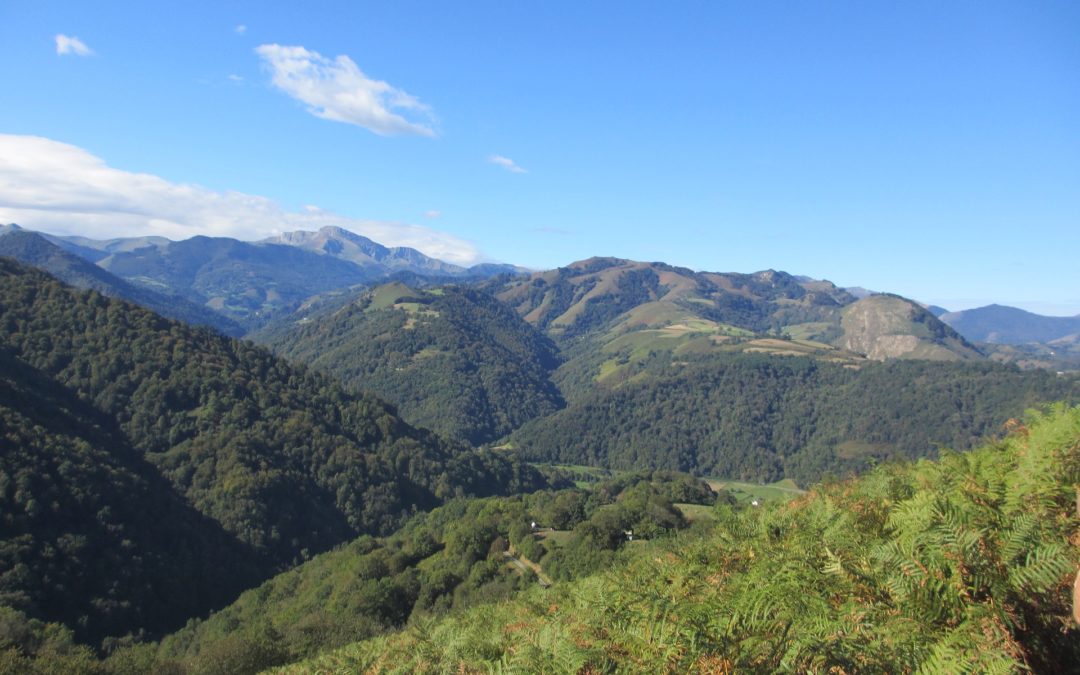
The village sits at the foot of the western Pyrenees, surrounded by paths, ridges and farmland, yet the Atlantic coast is close enough for an easy day trip. The Camino de Santiago passes through the village, the GR10 crosses the surrounding mountains and some of the region’s best-known walking areas are only a short drive away.
You can spend one day walking straight from Ainhoa, another exploring the hills around Sare or La Rhune, and the next beside the ocean.
And because the French-Spanish border is only a few kilometres away, a walking holiday here can easily extend into Navarre too.
Walk straight from the village
One of the biggest advantages of staying in Ainhoa is that you do not always need to get in the car before you start walking.
Paths leave the village almost immediately and climb towards the surrounding hills.
One of the classic local walks is the climb towards the Hawthorn Chapel, set above Ainhoa with views back over the village and the surrounding countryside.
From these lower slopes, longer routes continue into the mountains, making it easy to choose between a short morning walk and something considerably more ambitious.
For anyone who enjoys being able to put on their walking shoes at the door, this is a real advantage.
→ Discover our guide to hiking around Ainhoa
Follow the Camino de Santiago
Ainhoa lies on the Camino Baztanés, the historic route linking Bayonne with Pamplona through the western Pyrenees.
Pilgrims have crossed this landscape for centuries, travelling through Ainhoa before continuing towards the Spanish border and Navarre.
You do not need to be walking all the way to Santiago to enjoy it.
Following part of the Camino makes an excellent day walk and gives the landscape a completely different context. Old paths, village churches and mountain passes suddenly become part of a much longer story connecting France, Spain and Santiago de Compostela.
→ Read the history of Ainhoa and the Camino
The GR10 is close by
For more experienced walkers, the GR10 is one of the great long-distance routes of the French Pyrenees.
It runs from the Atlantic coast towards the Mediterranean, crossing the mountain chain from west to east.
The western stages pass through the Basque Country and are accessible from the area around Ainhoa, opening up much longer days in the mountains for anyone who wants them.
You do not have to be crossing the entire Pyrenees to enjoy the GR10. Walking a section for a few hours or a full day gives you a taste of one of France’s classic mountain routes without committing to weeks on the trail.
Explore Sare and La Rhune
A short drive from Ainhoa brings you to Sare, another excellent base for walking.
The countryside around the village is crossed by footpaths and old tracks, while the slopes of La Rhune dominate the landscape.
La Rhune is one of the most recognisable mountains in the western Basque Country and offers much more demanding walking than its modest altitude might suggest.
There are several ways to approach the mountain, depending on how much climbing you want to do.
And if you decide you would rather admire the views than walk every metre of the ascent, there is always the little mountain railway from the French side.
Cross into Navarre
One of the pleasures of walking from Ainhoa is how quickly the landscape continues across the border.
Just beyond Dantxarinea are Urdax and Zugarramurdi, followed by the green hills and villages of the Baztan Valley.
The geography does not suddenly change because you have crossed from France into Spain. The same mountains, farmhouses and Basque culture continue on both sides.
But the walking experience can feel subtly different, with new villages, routes and landscapes to explore.
It is perfectly possible to spend the morning walking in France and have lunch in Navarre.
Mix mountain walking with coastal paths
A walking holiday here does not have to mean mountains every day.
The Atlantic is close enough to provide a complete change of scenery.
Around Saint-Jean-de-Luz, Guéthary, Bidart and Biarritz, coastal walks offer ocean views, cliffs, beaches and small seaside towns.
These routes can be especially welcome after a demanding mountain day.
Walk beside the Atlantic in the morning, stop somewhere for lunch and return to Ainhoa before evening.
It is one of the reasons the area works so well for a longer walking holiday: you are unlikely to feel that every day looks the same.
→ Discover the beaches near Ainhoa
Stop in the villages along the way
Walking in the Basque Country is not only about reaching summits.
Some of the most enjoyable days involve linking villages, walking through farmland and stopping somewhere for lunch.
Ainhoa, Sare, Espelette and Itxassou are all surrounded by countryside that rewards slower exploration.
This is a landscape shaped by farming and rural life, and walking allows you to notice things that are easy to miss from a car: old farmhouses, sheep pastures, stone walls, woodland paths and small chapels.
There is also something particularly satisfying about arriving in a village on foot and sitting down for coffee or lunch.
Look out for Pottoks and sheep
The hills of the French Basque Country are working landscapes, and you will often share them with animals.
You are likely to encounter flocks of sheep and may also see Pottoks, the small native ponies of the Basque mountains.
They are one of the most distinctive sights in this part of the Pyrenees, especially when seen grazing on open slopes.
Give livestock plenty of space, do not feed the animals and leave gates as you find them.
The fact that the landscape is still actively farmed is part of what makes walking here so interesting.
→ Discover the Pottok, the native pony of the Basque Country
Spring and autumn are particularly good for walking
Summer is beautiful, but it can also be hot.
For longer days on foot, spring and early autumn are often particularly pleasant.
In spring, the countryside is intensely green and the days are getting longer. In autumn, the temperatures become more comfortable again and the busiest weeks of the summer season are over.
Both seasons still require flexibility.
Rain, mist and rapidly changing mountain weather are part of walking in the western Pyrenees.
The advantage of staying in Ainhoa is that if the mountains disappear into cloud, there is always another option.
→ 10 reasons to visit the French Basque Country in spring
Take the weather seriously
The mountains around Ainhoa are not particularly high compared with the central Pyrenees, but they should not be underestimated.
Cloud can descend quickly, paths become slippery after rain and a route that looks simple on a map may involve considerably more climbing than expected.
Check the forecast, carry water, wear suitable shoes and take a proper map or downloaded route.
And if the conditions do not look good, change your plans.
There will always be another walk.
→ Hiking in the French Basque Country: 10 things to know before you go
Walking is only part of the holiday
One of the best things about a walking holiday in Ainhoa is that you do not need to walk every day.
A rest day can mean visiting the coast, exploring Bayonne, crossing into Spain, going to a market or simply spending a long lunch discovering local food.
Ossau-Iraty cheese, gâteau basque, Espelette pepper and local produce are all part of the experience.
If the weather turns wet, the region also has caves, museums, markets and spas.
A walking holiday is much easier to enjoy when taking a day off does not feel like wasting a day.
→ What to do in the French Basque Country when it rains
Why choose Ainhoa for a walking holiday?
Ainhoa offers a combination that is surprisingly difficult to find.
You can walk directly from the village, reach serious mountain routes within a short distance, follow the Camino, explore the GR10, cross into Navarre and still be beside the Atlantic in less than an hour.
The village itself is small enough to feel peaceful, yet well placed for discovering a much wider part of the Basque Country.
For walkers, that flexibility matters.
You do not have to decide in advance whether your holiday will be about mountains, villages or the sea.
From Ainhoa, it can easily be all three.
Continue exploring
→ Hiking around Ainhoa: Camino, GR10 and local walks
→ Hiking in the French Basque Country: 10 practical tips
→ The history of Ainhoa and the Camino de Santiago
→ The Pottok, the native pony of the Basque Country
→ What to do in the French Basque Country when it rains
→ 10 reasons to visit the French Basque Country in spring