The History of Ainhoa: a Basque Village on the Border and the Camino
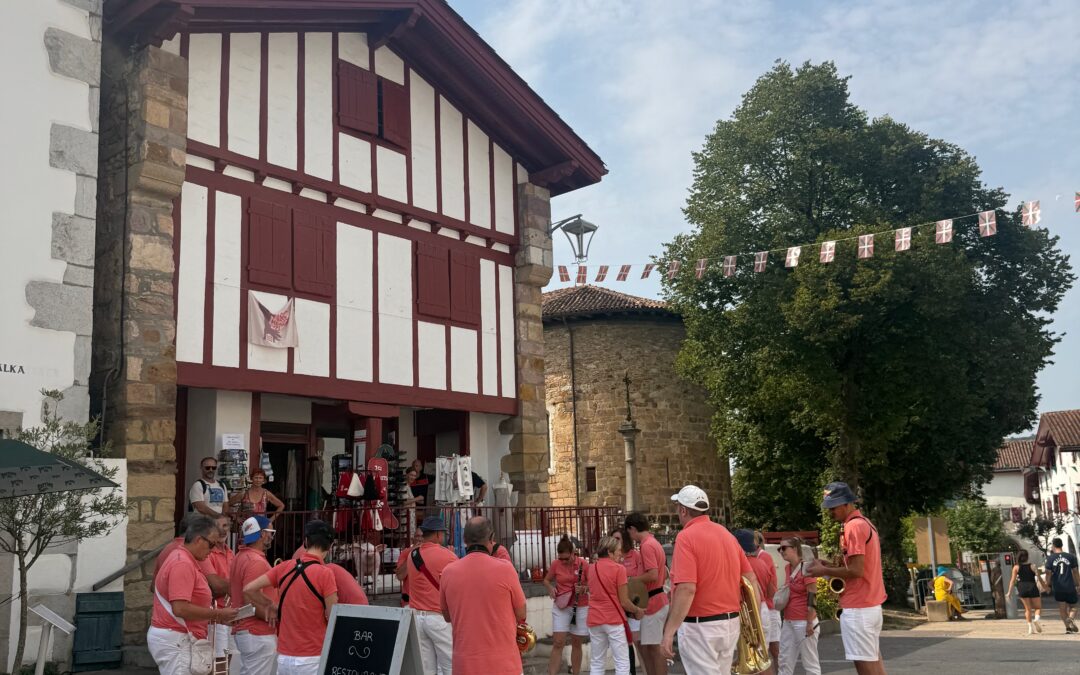
At first glance, Ainhoa can seem almost unchanged by time: one long street lined with whitewashed Basque houses, red and green timberwork, a church, a pelota court and mountains rising all around.
Yet behind that peaceful appearance lies a much more eventful past. The history of Ainhoa has been shaped by its position between Labourd and Navarre, by pilgrims travelling the Camino de Santiago, by border conflicts and by centuries of rural life in the Basque mountains.
To understand Ainhoa, it is worth looking beyond its famously beautiful main street.
A village born on the Camino de Santiago
Before the village itself developed, these hills and pastures were used by shepherds moving their animals through the landscape.
During the Middle Ages, Premonstratensian monks from nearby Urdax helped establish a settlement here on the pilgrimage route to Santiago de Compostela. Working with Juan Pérez de Baztan, the Navarrese lord who controlled the land, they gradually created the village that became Ainhoa.
Its position was no accident. Ainhoa developed as a stopping place where pilgrims could rest, find food and shelter, and prepare for the journey across the Pyrenees.
That history is still visible today. Ainhoa lies on the Camino Baztanés, the historic Camino route connecting Bayonne with Pamplona before joining the wider network of trails towards Santiago de Compostela.
Long before Ainhoa became one of the Plus Beaux Villages de France, it was already a village shaped by travellers passing through.
Why does Ainhoa have just one main street?
One of the most striking things about Ainhoa is its layout.
Rather than a maze of narrow streets, the historic village is organised around a single broad central road, with houses arranged in long rows on either side. This type of medieval settlement is known as a bastide-rue, or street bastide.
The structure created centuries ago is essentially the structure visitors still see today.
Most of the houses lining the main street date from the 17th and 18th centuries. Their large white façades, coloured timberwork, balconies and carved lintels give Ainhoa the architectural unity for which it is now famous.
There is also an interesting detail to notice as you walk through the village. Traditional Basque houses were generally oriented towards the east to protect them from Atlantic weather. In Ainhoa, however, the strict alignment along the main street meant that not every house could face the same direction.
As a result, the two sides of the street are not quite as symmetrical as they might first appear.
Between Labourd, Navarre and Spain
To understand Ainhoa’s history, it helps to look at a map.
The village lies close to the historic boundary between Labourd and Navarre, only a few kilometres from what is now the Spanish border.
During the 13th and 14th centuries, this part of the Basque Country lay between competing powers, including England and the Kingdom of Navarre. Ainhoa itself passed through different spheres of influence before eventually becoming part of the Kingdom of France in the 15th century.
That border position has never completely disappeared from the character of the area.
Today Ainhoa, Sare, Urdax and Zugarramurdi form the cross-border territory known as Xareta. The international boundary is very real, of course, but language, old paths, family connections and the mountain landscape have always linked the two sides of the Pyrenees.
For visitors today, crossing from France into Navarre takes only a few minutes. Historically, those connections were far more significant than a line on a modern map might suggest.
A village destroyed and rebuilt
The beautifully preserved houses along Ainhoa’s main street can give the impression that the village has survived untouched for centuries.
It has not.
Ainhoa suffered badly during the Thirty Years’ War in the 17th century. Much of the village was destroyed, and according to local history, the house known as Matxitorenea may be the only surviving dwelling in the centre dating from before that destruction.
Much of Ainhoa therefore had to be rebuilt.
This helps explain why so many of the houses visitors admire today date from the 17th and 18th centuries. The visual harmony of Ainhoa is partly the result of a village rebuilding itself after a period of conflict.
The church and cemetery at the heart of the village
At one end of the main street stands the Church of Notre-Dame-de-l’Assomption.
The building is thought to have developed from an earlier fortified structure and became a church during the Middle Ages. Inside, it has many features characteristic of traditional churches in Labourd, including a single nave surrounded by several levels of wooden galleries.
The church has been protected as a historic monument since 1996.
The cemetery around it is equally worth exploring.
Here you can see traditional Basque discoidal grave stelae, known as hilarri. Their distinctive circular forms are carved with geometric, religious and symbolic motifs and are one of the most recognisable elements of traditional Basque funerary art.
Together, the church and cemetery provide a glimpse into the religious and community life that shaped Ainhoa for generations.
The Hawthorn Chapel above Ainhoa
High above the village on the slopes of Atsulai stands the small Chapel of Notre-Dame de l’Aubépine, Our Lady of the Hawthorn.
Local tradition says that a young shepherd once saw an apparition of the Virgin Mary beside a hawthorn bush on the hillside, and that a chapel was later built on the site.
Beside it stand a calvary and reproductions of traditional Basque grave stelae.
Today, the climb from Ainhoa to the chapel is one of the loveliest walks around the village. At around 389 metres above sea level, the hillside offers wide views across Xareta and the Nivelle valley and, in clear weather, towards the Atlantic coast.
→ Discover the walk to the Hawthorn Chapel
A lesser-known mining past
Ainhoa is much more readily associated with sheep, farming and whitewashed houses than with industry.
Yet the surrounding area also has an old mining and metalworking history.
The Premonstratensian monks were involved in exploiting local resources, and the country between Ainhoa and Urdax once contained mines and forges. Some local place names still preserve traces of these activities.
It is a less familiar aspect of local history, but a useful reminder that the Basque mountains were not simply agricultural landscapes. They also provided raw materials, fuel and work.
This industrial past is particularly interesting at Les Hauts d’Ainhoa, where the old lime kiln beside Maison Labatchenia is another surviving reminder of the ways in which local stone and the mountain landscape were once put to practical use.
→ Read the story of the old lime kiln
Dantxaria and the border
South of the village lies Dantxaria, facing Dantxarinea on the Spanish side and the Navarrese village of Urdax beyond.
The two sides are separated by the small Lapitxuri stream.
Today, you can cross the border almost without noticing. Historically, however, the proximity of Navarre influenced everyday life in Ainhoa for centuries — through trade, travel, pastoral routes and the movement of people across the mountains.
It also explains why Ainhoa is such a convenient base for exploring both sides of the Basque Country today. Urdax, Zugarramurdi and the Baztan Valley are all within easy reach, connected by roads and paths that long predate modern tourism.
Ainhoa today: a village where history is still visible
Today Ainhoa is officially recognised as one of the Plus Beaux Villages de France, and its remarkably coherent architecture naturally attracts visitors.
But the village becomes much more interesting once you understand that its appearance is not simply picturesque.
The single street reflects its medieval origins. The Camino recalls its role as a stopping place for pilgrims. The houses tell a story of destruction and rebuilding. The church and Basque stelae preserve centuries of religious and community life. And beyond the hills, Navarre and the Spanish border remain only a few kilometres away.
Ainhoa’s character comes from this mixture of mountains, borders, ancient paths and deeply rooted Basque traditions.
Its history is not hidden away in a museum.
It is still there in the shape of the street, the stones of the houses and the paths leading out into the hills.
Continue exploring:
→ Discover Ainhoa and the French Basque Country
→ Hiking around Ainhoa, the Camino and the GR10
→ Discover the best beaches near Ainhoa
→ The Pottok: the little pony of the Basque mountains