What to eat in the French Basque Country: 8 local specialities
Food is one of the easiest ways to understand the French Basque Country.
The cooking here is generous rather than complicated, shaped by sheep farming, small-scale agriculture, the Atlantic coast and the influence of neighbouring Navarre and the Spanish Basque Country.
Around Ainhoa, many of the ingredients that appear on restaurant menus are still produced locally: sheep’s milk cheese, Espelette pepper, charcuterie, vegetables, cherries and gâteau basque.
If you are visiting for the first time, these are eight Basque specialities worth looking out for.
1. Ossau-Iraty
Start with the cheese.
Ossau-Iraty is the traditional sheep’s milk cheese of the French Basque Country and Béarn. It has AOP status and is made from the milk of three local breeds of sheep: Manech tête rousse, Manech tête noire and Basco-Béarnaise.
Young Ossau-Iraty is generally mild and supple, while longer ageing gives it a firmer texture and deeper, nuttier flavours.
You will see it almost everywhere: on market stalls, in farm shops, in restaurants and on cheese boards.
Around Ainhoa, it is also possible to buy directly from local producers.
→ Discover Ossau-Iraty and where to buy it around Ainhoa
2. Gâteau basque
The gâteau basque is probably the region’s best-known dessert.
Despite its name, it is not really a light cake. It is closer to a rich pastry, with a buttery dough surrounding a filling traditionally made with either pastry cream or black cherry jam.
The two versions inspire surprisingly strong opinions.
Around Ainhoa and Sare you will find both, so the sensible solution is to try each and decide for yourself.
In Sare, there is even a museum devoted to the history and making of gâteau basque.
It also travels well, which makes it one of the easier Basque specialities to take home.
3. Piment d’Espelette
The bright red peppers hanging from the façades in Espelette have become one of the most recognisable images of the French Basque Country.
But piment d’Espelette is much more than decoration.
The dried pepper has an AOP and is used throughout local cooking to add warmth and flavour rather than extreme heat.
You may find it in piperade, axoa, charcuterie, sauces and even chocolate.
When buying it, look for genuine Piment d’Espelette AOP rather than simply a generic pepper product sold as a souvenir.
Espelette is only a short drive from Ainhoa, making it an easy stop during a stay.
→ See our 3-day itinerary from Ainhoa
4. Axoa
If there is one dish particularly associated with the inland French Basque Country, it is axoa.
Traditionally associated with the area around Espelette, axoa is usually made with finely chopped veal cooked with onion, peppers and piment d’Espelette.
It is simple, warming food rather than elaborate restaurant cuisine, and is often served with potatoes.
Recipes vary considerably from one family or restaurant to another, which is part of the point.
It is especially worth ordering if you are staying inland rather than only visiting the coastal towns.
5. Jambon de Bayonne
Jambon de Bayonne is a cured ham produced in south-west France and closely associated with the Adour basin and the Basque Country.
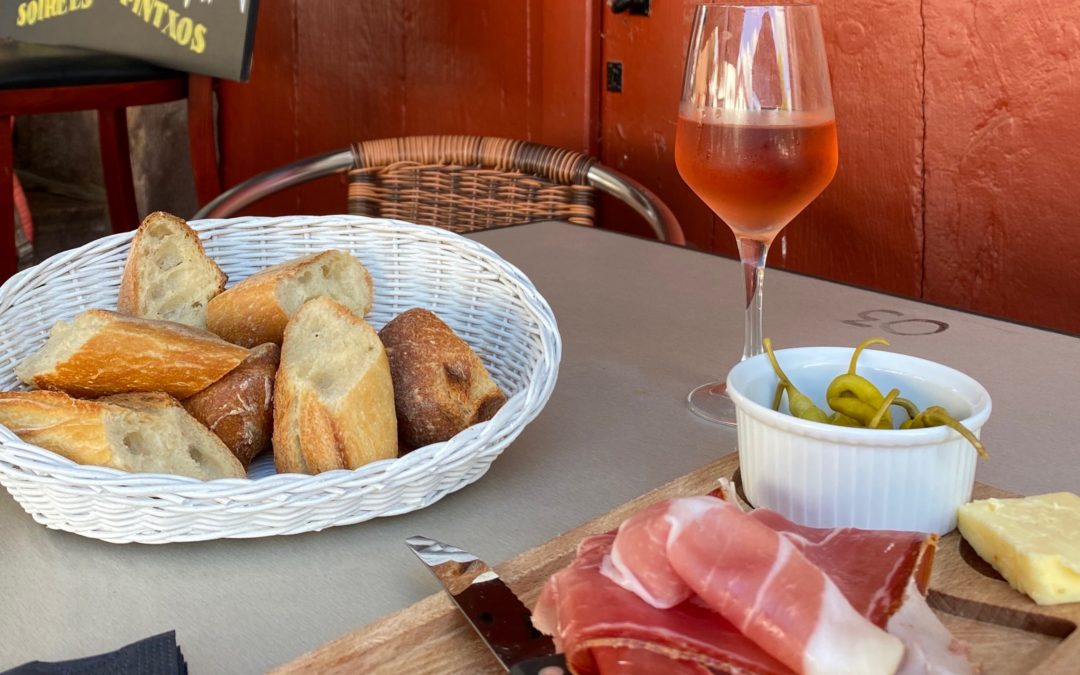
It is usually served thinly sliced, either on its own, with bread or as part of a plate of local charcuterie.
Despite the name, the pigs do not need to come from Bayonne itself. The designation relates to a wider protected production area and traditional curing process.
For visitors, the important bit is considerably simpler: when you see good Bayonne ham cut fresh at a market or delicatessen, try it.
It makes a particularly good partner for local cheese and bread.
6. Piperade
Piperade is one of the simplest dishes in Basque cooking and one of the most useful to know.
It is made with peppers, tomatoes and onions, generally seasoned with piment d’Espelette.
It may be served on its own, with eggs, alongside meat or as part of another dish.
Like many regional recipes, there is no single version that appears everywhere.
What matters is the combination of sweet peppers, tomatoes and the gentle warmth of Espelette pepper — ingredients that immediately taste of this part of the country.
7. Ttoro and seafood from the Basque coast
Head down to Saint-Jean-de-Luz and the cooking changes with the landscape.
Ttoro is a traditional Basque fish stew associated particularly with the fishing ports of the coast. Depending on the catch and the cook, it may contain several kinds of fish and shellfish in a rich tomato-based sauce.
You will also see hake, tuna, anchovies and chipirons — small squid — on menus along the coast.
This is one reason it is worth spending part of a stay in Ainhoa exploring Saint-Jean-de-Luz rather than treating the mountains and coast as completely separate destinations.
Lunch beside the Atlantic feels very different from lunch in Espelette, even though the two are not far apart.
→ Discover the beaches and coast near Ainhoa
8. Basque black cherry jam
Black cherry jam is most famous as the traditional accompaniment to sheep’s milk cheese.
A slice of Ossau-Iraty with a little confiture de cerises noires is one of the simplest combinations you will find on a Basque table.
The cherries are particularly associated with villages such as Itxassou, although the jam is sold throughout the region.
It is sweet, slightly sharp and works particularly well with the saltiness of an aged sheep’s cheese.
You will also encounter black cherry in gâteau basque.
If you are putting together a simple Basque picnic, bread, Ossau-Iraty, charcuterie and a jar of black cherry jam will get you a surprisingly long way.
Where to discover Basque food around Ainhoa
You do not need to plan an elaborate gastronomic tour.
Ainhoa itself has local producers nearby, while Espelette, Sare, Saint-Jean-de-Luz and Bayonne each offer a different side of Basque food.
A useful approach is simply to combine food with whatever you are already doing.
Visiting Espelette? Look for piment d’Espelette and try axoa.
Going to Saint-Jean-de-Luz? Browse the Halles and eat fish.
Walking around Ainhoa? Stop at a farm for local sheep’s cheese.
Rainy day? Spend longer at a market, food producer or over lunch.
→ What to do in the French Basque Country when it rains
Markets, farm shops or restaurants?
All three.
Markets are best for seeing the range of local produce and putting together a picnic.
Farm shops and producers are particularly worthwhile for cheese and other products made locally.
Restaurants let you try dishes such as axoa, piperade and ttoro without needing to understand how they are made first.
And there is no need to seek out the most elaborate menu.
Some of the best food here is extremely simple.
Eating in Ainhoa: from farm cheese to Michelin-starred cooking
For such a small village, Ainhoa has a surprisingly rich food scene.
At one end of the spectrum, you can buy Ossau-Iraty directly from farms around the village. At the other is Ithurria, Ainhoa’s Michelin-starred restaurant, where the cooking is rooted in produce from the Basque Country and Béarn.
There is also a much more informal side to the same food culture.
At the time of writing, the Ezkurra café in the centre of Ainhoa is being run by the Ithurria team. It is the sort of place where you might stop for a slice of tortilla — Spanish omelette — made by Ithurria, or a glass of one of their homemade syrups, rather than sit down for a full restaurant meal.
That contrast is part of what makes eating in Ainhoa so enjoyable: within the same small village, you can go from cheese bought directly at a farm to a simple café stop and, if the occasion calls for it, a Michelin-starred dinner.
As Ezkurra is currently for sale, this is one detail worth checking before a future visit, as the café may not always be run in the same way.
Eating your way around the French Basque Country
The interesting thing about Basque food is how closely it follows the landscape.
Inland, sheep farming gives you Ossau-Iraty. Around Espelette, peppers dominate. Move towards Bayonne and charcuterie becomes more prominent. Reach Saint-Jean-de-Luz and the Atlantic begins to appear on the plate.
That makes food a particularly good way to explore the region from Ainhoa.
You do not need a separate gastronomic itinerary.
Just pay attention to what is produced wherever you happen to be that day — and arrive hungry.
Continue exploring
→ Ossau-Iraty: the sheep’s milk cheese of the French Basque Country
→ 3 days in Ainhoa: villages, mountains and coast
→ Things to do in Ainhoa and the French Basque Country
→ What to do in the French Basque Country when it rains
→ 10 reasons to visit the French Basque Country in spring