
Hiking in the French Basque Country: 10 things to know before you go
The green hills around Ainhoa can look gentle, but walking in the French Basque Country is still mountain walking.
Paths can be steep, weather changes quickly and a sunny village morning does not necessarily mean clear skies higher up. At the same time, you do not need to be an experienced mountaineer to enjoy the landscape. There are wonderful walks for almost every level, from short climbs above Ainhoa to long-distance routes such as the GR10 and the Camino de Santiago.
A little preparation makes all the difference.
Here are 10 things worth knowing before you set off hiking in the French Basque Country.
1. Don’t judge the weather from the village
Ainhoa can be sunny while the surrounding peaks are hidden in cloud.
Weather moves quickly between the Atlantic coast and the western Pyrenees, and conditions can change significantly during a walk. Mist can arrive surprisingly fast and rain showers are part of life here even in summer.
Check the forecast before leaving, but also look at the mountains themselves.
If the summits disappear into cloud, it may be better to choose a lower-level walk and save the high ground for another day.
2. Wear proper shoes
Many Basque trails are old paths rather than smooth recreational tracks.
You may encounter rock, mud, uneven ground, steep grassy slopes and sections made slippery by rain. Even relatively short walks can feel very different after a wet night.
Walking shoes or lightweight hiking boots with a good grip are usually a much better choice than ordinary trainers.
And after rain, expect mud. Lots of it.
3. Take water, even for a short walk
Distances on a map can be deceptive when there is a steep climb involved.
Carry enough water, particularly in late spring and summer. There may be streams or fountains along the way, but you should not rely on finding drinking water unless you know a route well.
A small snack is useful too. A climb that looks short from Ainhoa can take longer than expected once you start gaining height.
4. Learn the waymarking — but take a map as well
The French Basque Country has an extensive network of walking routes, including local trails, long-distance GR paths and the Camino de Santiago.
You will often see painted waymarks on rocks, posts and trees.
The GR10, which crosses the Pyrenees from the Atlantic to the Mediterranean, uses the familiar red-and-white GR markings. Other local routes may use different colours or signs.
Waymarking is useful, but signs can occasionally be missed, damaged or obscured by vegetation.
A downloaded offline map or walking app is a very useful backup — particularly in mist.
5. Don’t rely blindly on Google Maps
Google Maps is excellent for getting from Ainhoa to Bayonne.
It is considerably less reliable for deciding whether a faint line across a mountainside is a sensible walking route.
Some tracks shown on digital maps may be private, overgrown or unsuitable for walkers. Others may lead through farmland without being established public trails.
For hiking, use a proper walking map, a recognised route description or a dedicated hiking application.
For straightforward routes around Ainhoa, start with our guide to local walks.
→ Discover hiking around Ainhoa
6. Respect sheep, Pottoks and other livestock
You are very likely to share the landscape with animals.
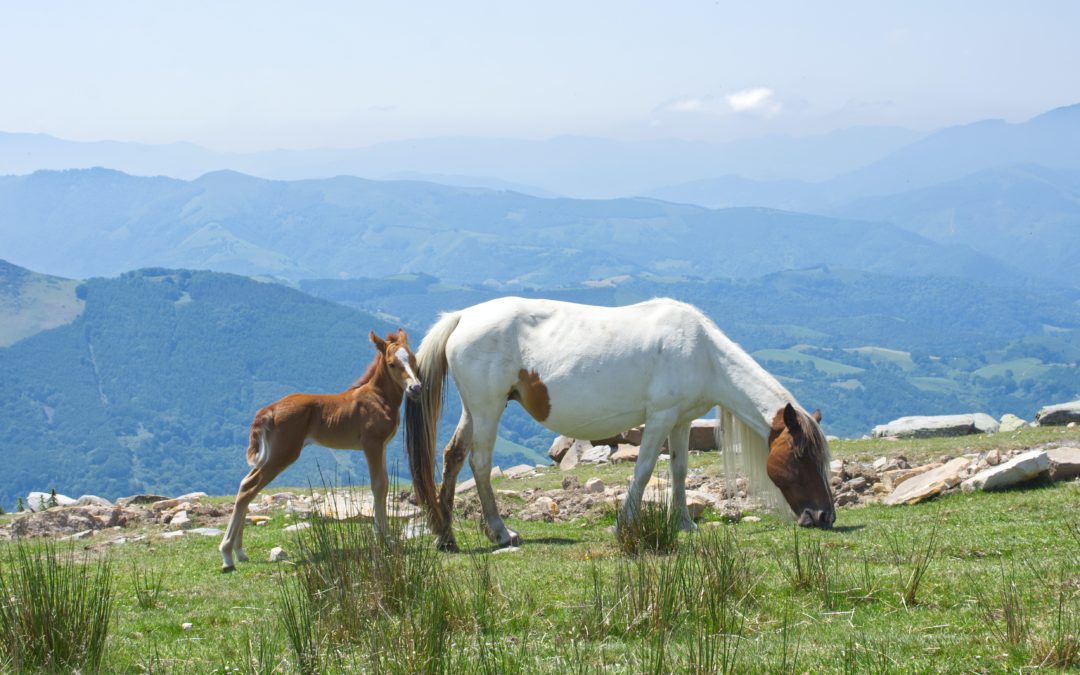
Sheep graze extensively in these mountains, and cattle and Pottoks, the small native Basque ponies, can also be encountered on open land.
Give animals plenty of space, particularly if they have young with them. Do not feed them and do not approach simply for a photograph.
Pottoks may look very relaxed — and usually are — but they are still free-ranging animals rather than pet ponies.
If you pass through a gate, leave it exactly as you found it.
→ Discover the Pottok, the native pony of the Basque Country
7. Be particularly careful if you are walking with a dog
Livestock changes the situation considerably when a dog is involved.
Keep dogs under close control around sheep, cattle and horses, and use a lead whenever necessary.
You may also encounter farm dogs protecting livestock or property. If so, stay calm, give them space and avoid walking directly towards the animals they are guarding.
Local restrictions can also apply at certain times or in protected areas, so check the rules for your chosen route before setting off.
8. Start early when it is hot
The Basque Country is green, but that does not mean summer is cool.
On sunny days, exposed slopes can become extremely hot by early afternoon, particularly on steep climbs with little shade.
Starting early gives you cooler walking conditions and often clearer mountain views.
It also leaves plenty of time for one of the great pleasures of hiking from Ainhoa: getting back to the village in time for lunch.
9. Remember that this is a working landscape
The countryside around Ainhoa is beautiful, but it is not an outdoor museum.
These mountains are used for farming, forestry and other rural activities. You may come across tractors, livestock, fences and working farms along routes that otherwise feel completely wild.
Hunting is also part of rural life, particularly during the cooler months. Pay attention to temporary notices and signs and, if you are unsure about local conditions, ask before heading into an area.
Respect private property and avoid shortcuts across fields simply because they appear more direct.
10. Know when to turn around
This may be the most useful hiking rule of all.
There is no shame in turning back because the cloud has descended, the path is too muddy, the heat is stronger than expected or the route is taking longer than planned.
The mountains will still be there tomorrow.
One advantage of staying around Ainhoa is that there is usually an alternative: choose a shorter valley walk, explore one of the nearby villages or head towards the coast instead.
And if the weather really closes in, there are plenty of ways to enjoy the region without hiking at all.
→ What to do in the French Basque Country when it rains
Hiking around Ainhoa
Ainhoa is an excellent base for walking because the mountains begin almost at the edge of the village.
You can climb to the Hawthorn Chapel, follow part of the Camino Baztanés, explore local marked trails or connect with longer routes through the western Pyrenees.
The important thing is not to underestimate the terrain simply because the mountains are relatively low.
Come prepared, keep an eye on the weather and allow yourself time to stop and look around.
That is usually when the best part of the walk begins.
Continue exploring
→ Hiking around Ainhoa: GR10, Camino and local walks
→ The Pottok: the native pony of the Basque Country
→ The history of Ainhoa and the Camino de Santiago
→ What to do in the French Basque Country when it rains
→ 10 reasons to visit the French Basque Country in spring