The Pottok: the little pony of the Basque mountains
Walk through the mountains of the French Basque Country and you may come across one of the region’s most distinctive inhabitants: the Pottok pony.
Small, sturdy and remarkably well adapted to life on the hillsides, Pottoks have lived in the Basque mountains for generations. They are as much a part of the local landscape as the Manech sheep, red-and-white villages and fern-covered slopes.
Around Ainhoa, they can sometimes be seen grazing on the surrounding hills, while larger free-ranging herds are particularly associated with mountain areas such as La Rhune.
What is a Pottok?
The Pottok is a native pony breed from the Basque Country on both sides of the French-Spanish border.
The name is Basque — pottok simply means a small horse or pony.
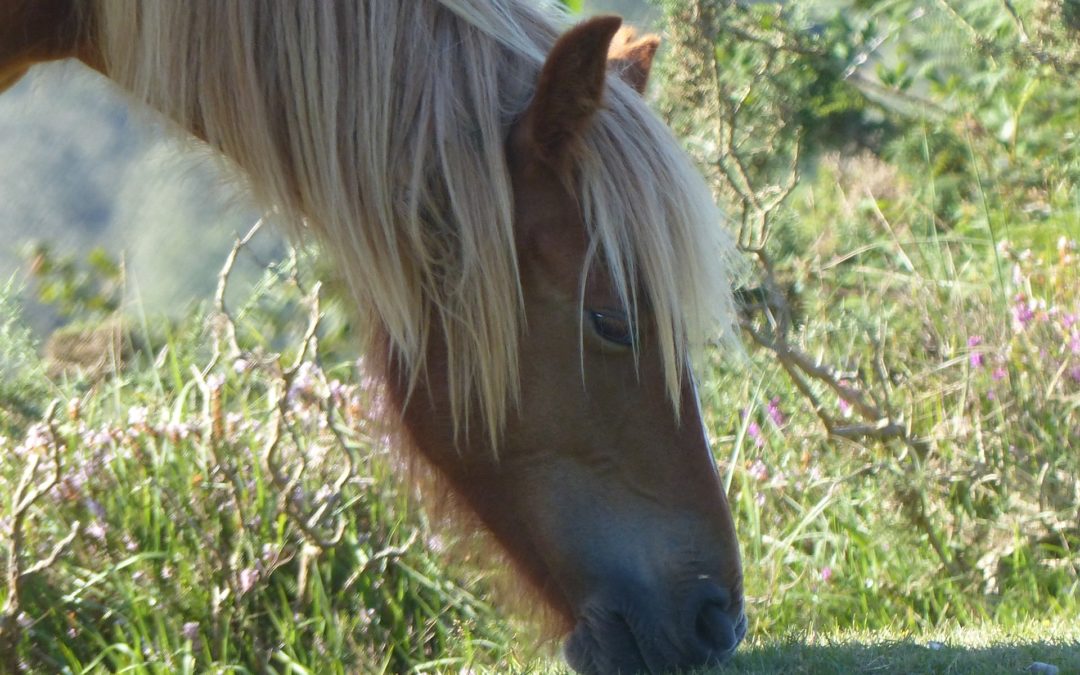
They are compact animals with strong legs, hard hooves and abundant manes, characteristics well suited to steep terrain and changing mountain weather. The official French breed standard recognises several coat colours including bay, black, chestnut and piebald. Mountain Pottoks generally stand between about 1.15 and 1.32 metres high.
They may look rather cuddly from a distance, but their toughness is what really defines them.
Are Pottoks really wild?
You will often see Pottoks described as wild Basque ponies, but free-ranging is usually more accurate.
Many mountain Pottoks live outdoors in herds for most of the year with very little intervention, which gives them an unmistakably wild appearance. However, they belong to breeders and the breed is managed and protected.
Under the French breed standard, a Pottok de montagne must live freely on recognised mountain massifs for at least nine months of the year as part of a herd containing mares, young horses and a stallion.
So the ponies you meet on a mountain walk should be treated as animals living in their own environment rather than as pets waiting to be stroked or fed.
A pony shaped by the Basque landscape
The Pottok’s small size makes perfect sense when you see where it lives.
Basque mountain pastures can be steep, wet, windy and surprisingly exposed. A smaller, sure-footed animal needs less food and can move easily across ground that would be difficult for a much larger horse.
Their grazing also has a role in maintaining these landscapes. Local nature walks organised around Ainhoa specifically highlight the Pottok’s contribution to grazing the mountain pastures and to local biodiversity.
They are therefore not simply something picturesque to spot on a walk: they form part of the ecology and agricultural history of the Basque hills.
Where can you see Pottoks near Ainhoa?
There is never a guarantee — they are not standing around waiting for visitors — but walking in the hills around Ainhoa gives you a chance of seeing Pottoks in their natural environment.
Ainhoa itself has hosted guided nature walks devoted specifically to discovering the Pottok, its behaviour and its role in the mountain landscape.
One of the easiest places for visitors to see them is La Rhune, above Sare. Pottoks live freely around the mountain, alongside Manech sheep and griffon vultures, and they are often visible near the summit and walking trails.
→ Discover our guide to hiking around Ainhoa
Seeing Pottoks responsibly
If you do encounter a herd, enjoy them from a little distance.
They may be accustomed to people passing through the mountains, but they remain free-ranging animals. Avoid feeding them, don’t walk between a mare and her foal, and keep dogs under close control.
Most importantly, there is no need to approach them for the perfect photograph. Seeing a small herd quietly grazing against the Basque mountains is far more memorable when they are simply allowed to carry on being Pottoks.
More than a postcard image
Pottoks have become one of the visual symbols of the Basque Country, but their significance goes deeper than that.
Their hardy build reflects the mountain environment in which they developed. Their free-ranging way of life continues an old relationship between livestock and common grazing land. And their presence helps maintain the open pastures that form such a familiar part of the Basque landscape.
For visitors to Ainhoa, spotting a Pottok on a walk is one of those small experiences that immediately places you in the Basque Country.
Not a tourist attraction. Not quite a wild horse.
Just a tough little mountain pony that belongs here.
Hiking around Ainhoa →
The history of Ainhoa →
Discover Ainhoa and the Basque Country →
Ossau-Iraty: the sheep’s milk cheese of the Basque Country →