Ossau-Iraty Cheese: A Taste of the French Basque Country
Travel through the inland French Basque Country and sheep are almost as much a part of the landscape as the white-and-red houses and green mountains. Their milk is used to make one of the region’s best-known foods: Ossau-Iraty cheese, a firm but melting sheep’s milk cheese traditionally produced in the French Basque Country and neighbouring Béarn.
Its flavour is usually subtle rather than overpowering, with notes that can range from fresh grass and flowers to nuts and fruit as the cheese matures. It is also closely tied to a pastoral way of life that has shaped these mountains for centuries.
What is Ossau-Iraty cheese?
Ossau-Iraty is a pressed, uncooked cheese made entirely from sheep’s milk. It carries the French AOP — Appellation d’Origine Protégée, or PDO in English — meaning that its origin and production methods are protected.
The appellation was first recognised as an AOC in 1980 and received European AOP status in 1996. The milk, cheesemaking and ageing must all take place within the designated production area.
The name itself joins two emblematic places at either end of its territory: the Ossau valley in Béarn and the Iraty forest in the Basque Country.
For visitors staying around Ainhoa, that makes it much more than simply a cheese from somewhere in southwest France. It is one of the foods most closely associated with the landscapes surrounding us.
Three local breeds of sheep
Only milk from three traditional local breeds can be used for AOP Ossau-Iraty:
Manech Tête Rousse, Manech Tête Noire and Basco-Béarnaise.
These hardy sheep are particularly well adapted to the wet climate, steep hills and mountain pastures of the western Pyrenees. They spend much of their time grazing outside, and many flocks still take part in summer transhumance, moving towards the higher mountain pastures as the seasons change.
If you walk in the hills around Ainhoa, you are very likely to see Manech sheep grazing along the way — particularly the distinctive black-faced Manech Tête Noire.
A cheese shaped by the mountains
Sheep farming in this part of the Pyrenees has very deep roots. Evidence of pastoral farming goes back to prehistoric times, while medieval documents record the production and trade of sheep’s milk cheese.
There was also a practical reason for making cheese in the mountains. Shepherds spending the summer with their flocks in high pastures needed a way to preserve the milk. Turning it into a firm cheese meant that it could later be carried back down into the valleys and sold or stored.
That relationship between the flock, the pasture and the mountains remains fundamental to Ossau-Iraty today.
Farmhouse or dairy Ossau-Iraty?
Not every Ossau-Iraty tastes the same.
A farmhouse Ossau-Iraty — Ossau-Iraty fermier — is made on the farm from the raw milk of the producer’s own flock. Other Ossau-Iraty cheeses are made in dairies using milk collected from several local sheep farmers.
Ageing makes another substantial difference.
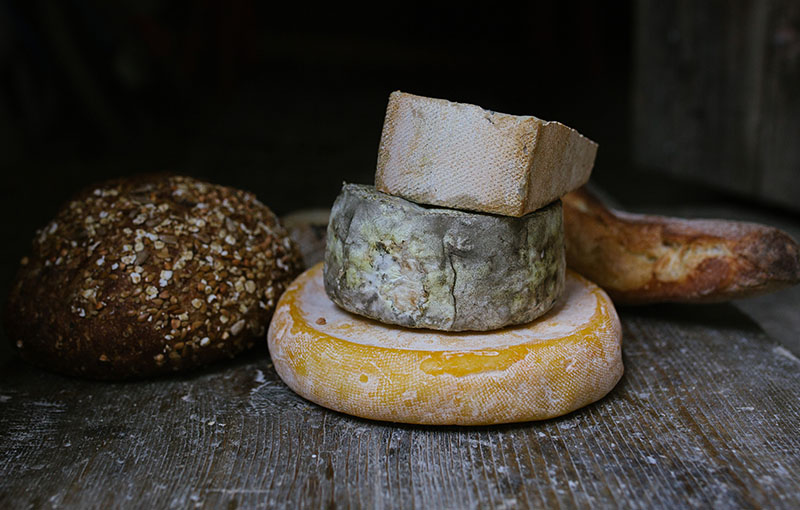
Younger cheeses tend to be mild, supple and creamy. With longer maturation, the texture becomes firmer and the flavours deepen, often developing more pronounced nutty, floral or grassy notes. The official Ossau-Iraty organisation notes that cheeses matured for six to eight months can reach a particularly expressive stage.
That variety is part of the pleasure: tasting two Ossau-Iraty cheeses side by side can reveal surprisingly different characters.
What does Ossau-Iraty taste like?
Despite being a sheep’s milk cheese, good Ossau-Iraty is not necessarily strong.
Its pale paste is smooth and dense, while the flavour typically balances richness with a slight freshness. Hazelnut is one of the notes most commonly associated with Ossau-Iraty, although depending on the season, producer and ageing, you may also notice floral, vegetal or fruity aromas.
For someone who thinks they do not particularly like sheep’s cheese, a relatively young Ossau-Iraty is often an excellent place to start.
Why is it served with black cherry jam?
One of the combinations you will frequently encounter in the Basque Country is sheep’s cheese served with black cherry jam.
The sweetness and slight acidity of the fruit work particularly well with a mature sheep’s cheese. The official Ossau-Iraty tasting guide also suggests quince jelly, walnuts or simply eating the cheese on its own to appreciate its flavour fully.
Personally, this is one of those cases where keeping things simple works best: a good piece of Ossau-Iraty, a little black cherry jam and some fresh bread make a very Basque end to a meal.
Discovering Ossau-Iraty in the Basque Country
One of the pleasures of staying inland rather than only visiting the coast is how visible food production still is.
Across the Basque Country and Béarn, the Route du Fromage AOP Ossau-Iraty links farms, cheesemakers and affineurs where visitors can discover the people behind the cheese. The current route includes more than a hundred stops across the production area.
You will also see local sheep’s cheeses at markets, farm shops and village food stores throughout the region.
Around Ainhoa, sheep farming is not something created for visitors. It is simply part of the working landscape, alongside the pastures, mountain paths and old farmhouses.
Buying Ossau-Iraty in Ainhoa
You do not have to travel far from Ainhoa to taste Ossau-Iraty at its source. Local farms around the village produce and sell sheep’s milk cheese directly, including farmhouse AOP Ossau-Iraty made from local Manech sheep.
Buying from a farm is a lovely way to understand the connection between the cheese and the landscape around Ainhoa: the sheep you see grazing on the hills are part of the same agricultural tradition behind one of the Basque Country’s best-known cheeses.
If you plan to visit a producer, it is worth checking opening times or calling ahead, as farm sales often work around the rhythms of everyday farm life.
A taste of the Basque landscape
Ossau-Iraty is worth seeking out because it tastes good, of course. But it also provides a particularly tangible introduction to the French Basque Country.
Behind each cheese lies a landscape of green hills and mountain pastures, local breeds of sheep, seasonal farming and generations of cheesemaking knowledge.
So while you are exploring Ainhoa and the surrounding villages, try more than one. A young farmhouse cheese, a longer-aged Ossau-Iraty and a slice served with black cherry jam may all carry the same protected name — yet taste remarkably different.
And that is part of what makes Ossau-Iraty cheese such an interesting expression of this corner of the Basque Country.